Read the University of Alaska Fairbanks Geophysical Institute’s forecast for its Kp, set to Alaska time, but treat the number as a hint, not a verdict: asked whether Kp can forecast the aurora in Fairbanks, the Institute answers “Yes and no”, because local activity can be high when the global figure is low. What decides a night is a clear, dark sky, so read the cloud forecast and the moon as closely, and be out from 9 p.m. to 3 a.m. AKST in winter. No forecast promises the aurora. It helps you choose which nights to stay up for, and where.
This page is for the aurora visitor already in Fairbanks, or a week out, deciding which nights to stay up and what to check before each one. Choosing the dates of a trip is the work of our best time to see the northern lights guide and our northern lights calendar for 2026–2027. A summer visitor has little to read the forecast for: from 22 April to 20 August, the Institute says, the sky over Fairbanks does not get dark enough to see the aurora “even if it was a spectacular display,” beyond very brief spells of twilight just after 21 April and just before 20 August.
How the forecasts work is as the Institute and NOAA’s Space Weather Prediction Center describe them on their pages, read on 23 November 2026; the cloud forecast is the National Weather Service’s, and the moon is the US Naval Observatory’s. Every clock time on this page is Alaska time: Alaska Standard Time (AKST, UTC-9) until 2:00 a.m. on 14 March 2027, and Alaska Daylight Time (AKDT, UTC-8) from then until 2:00 a.m. on 7 November 2027.
Where the Kp comes from
The Institute’s aurora forecast is NOAA’s forecast, shown its way. “We pull data from the NOAA Geomagnetic Forecast daily at noon UTC,” it says: NOAA’s forecast of geomagnetic activity “for the next three UTC days, provided in 3-hour intervals”, which “NOAA updates … daily at 22:05 UTC.” In Fairbanks that is a pull at 3:00 a.m. AKST of a forecast NOAA issued at 1:05 p.m. AKST the afternoon before (4:00 a.m. and 2:05 p.m. under AKDT).
So by the Institute’s own timetable, from 1:05 p.m. AKST until its next pull at 3:00 a.m., NOAA’s own Geomagnetic Forecast is a day newer than the chart on the Institute’s page, and reaches a day further. On the afternoon of a night you are weighing, read NOAA’s: its first lines give the time it was issued, in UTC. For the reasons behind the numbers, NOAA’s plain-language 3-Day Forecast carries a forecaster’s rationale and is issued every 12 hours, at 0030 and 1230 UTC (3:30 p.m. and 3:30 a.m. AKST).
The Institute’s page shows the forecast three ways: a 3-day forecast it labels “More Reliable”, a 27-day forecast it labels “Less Reliable”, and the historical data, “the highest activity for each day” over “the 180 most recent days” of NOAA’s observed figures. Its charts color each value by whether it is below Kp 4, at 4 or above 4, and the top of the page gives the day’s forecast in three-hour blocks beside the moon’s phase.
What the Kp number measures
Kp is a scale of geomagnetic activity from 0 to 9, computed, in the Institute’s words, “by averaging the magnetic activity from around eight stations around the world every three hours.” NOAA names the eight magnetometers behind its estimated three-hour Kp: Sitka, Alaska; Meanook and Ottawa, Canada; Fredericksburg, Virginia; Hartland, UK; Wingst and Niemegk, Germany; and Canberra, Australia. None is in Fairbanks. The Institute’s page says in another answer that Kp comes from “equatorial magnetometer stations”; NOAA, whose figure it is, places the official index’s 13 observatories between 44 and 60 degrees of geomagnetic latitude, and we go by NOAA. Either way it is a global figure, and the Institute says the forecasts that use it “rely on the Kp index as an indicator of the auroral oval size”: how far the band of aurora around the magnetic pole has spread.
NOAA’s storm scale shows what that means. Its geomagnetic storms run from G1 (minor) at Kp 5, through G2 (moderate) at 6, G3 (strong) at 7 and G4 (severe) at 8, including a 9-, to G5 (extreme) at 9, and it describes each step by how far south the aurora has been seen: as low as New York and Idaho at G2, Alabama and northern California at G4. The two sources draw the storm line a step apart. NOAA counts Kp 5 as a storm (“5 or more indicating a geomagnetic storm”); the Institute’s page says “Anything above a Kp 5 is classified as a geomagnetic storm.” The forecast’s numbers are NOAA’s, so NOAA’s scale is the one to read them by.
Why Kp says less in Fairbanks
The Institute puts the question directly: “Can the Kp forecast the aurora in Fairbanks? Yes and no.” When global activity is higher, the chance of aurora rises everywhere, “However, local conditions could be quite different from global activity.” “Auroral phenomena are more closely related to substorms,” it says, which are used “to define the almost nightly occurrences of auroral activity”. And of the auroral oval: “Inside the auroral oval, however, Kp is less relevant, since even when global activity is low, auroral activity can be high.”
It lists Fairbanks among the places that, at average activity, “offer a good chance to view the aurora overhead.” So a low Kp is no reason on its own to stay in on a clear night here, and a high one is no promise. The Institute names “sunlight and clouds” as “the biggest obstacles to observing this elusive phenomenon”, not a low number.
NOAA’s hours in Alaska time
NOAA’s forecast tables are in UTC. Under AKST, UTC is nine hours ahead, so a Fairbanks evening and the night after it sit under the next day’s date: the night of 1 to 2 December is in NOAA’s column for 2 December. The table below puts each of NOAA’s three-hour blocks in Alaska time. The Institute’s page has a Time Zone menu above its map and above its chart; set it to Alaska and it does this for you, though it warns that “When converted between time zones, the forecast may overlay more or less than three days.”
| NOAA’s block (UTC) | Under AKST, to 14 March 2027 | Under AKDT, from 14 March 2027 |
|---|---|---|
| 00–03UT | 3 p.m. to 6 p.m., the day before | 4 p.m. to 7 p.m., the day before |
| 03–06UT | 6 p.m. to 9 p.m., the day before | 7 p.m. to 10 p.m., the day before |
| 06–09UT | 9 p.m. to midnight, the day before | 10 p.m. the day before to 1 a.m. |
| 09–12UT | Midnight to 3 a.m. | 1 a.m. to 4 a.m. |
| 12–15UT | 3 a.m. to 6 a.m. | 4 a.m. to 7 a.m. |
The Institute’s best winter hours, 9 p.m. to 3 a.m. AKST, are NOAA’s 06–09UT and 09–12UT blocks. Under AKDT, the same clock hours are 05:00 to 11:00 UTC.
A week or more out: the 27-day outlook
For a night beyond the 3-day forecast, the Institute’s page carries NOAA’s 27-Day Space Weather Outlook, which it pulls “every Monday at noon UTC” (3:00 a.m. AKST). NOAA issues it on Mondays, “by 1500 UTC” (6:00 a.m. AKST), with one Kp for each UTC date, the day’s largest. Its basis is the sun’s rotation, about once every 27 days: “if there is high auroral activity today,” the Institute says, “it’s possible that there will be high auroral activity again in 27 days.” The 3-day forecast stands on firmer ground: material erupting from the sun takes 1 to 3 days to reach Earth, which, in the Institute’s words, “allows relatively accurate forecasts to be made on these look-ahead time scales.” Where the two overlap, the Institute highlights the 3-day figures in blue on the 27-day chart.
Read the 27-day outlook for a hint of a busy week, never to keep a night or drop one. The Institute’s own measure of what to expect is wider than any one forecast: in its season, roughly 21 August to 21 April, “if the weather is clear and you stay for at least three nights, it’s highly likely (though never certain!) that you will see the aurora.”
The clouds decide the night
“There is always some aurora at some place on Earth,” the Institute says; “however, the sky must be dark and at least partially clear in order for the aurora to be visible.” It adds: “the clearer the sky, the more aurora that can be seen.” None of the aurora forecasts above forecasts the cloud.
For that, the National Weather Service’s Fairbanks office publishes a tabular point forecast: 48 hours at a time, hour by hour in AKST, it gives the sky cover as a percentage, beside the temperature and the wind chill. Read the rows from 9 p.m. to 3 a.m. AKST. It is a forecast for one point, given by its latitude and longitude, so set it to the hill you plan to watch from, not only to town.
Our northern lights tours page sets out what each operator does when the sky clouds over.
The moon
“When the moon is full or close to full,” the Institute says, “the added ambient light may prevent you from seeing dim auroral features. However, this same effect also may enhance their colors.” For photographs it is plainer: “third-quarter or new moon phases are best.”
Whether the moon is up during your hours matters as much as its phase. The Naval Observatory’s Complete Sun and Moon Data for One Day gives the rise and set of the sun and moon, civil twilight and the moon’s phase for a date and place you choose. For Fairbanks, six days after the full moon of 24 November 2026, it puts moonset at 1:53 p.m. AKST on 30 November, the end of civil twilight at 4:16 p.m. and the next moonrise at 12:04 a.m. on 1 December: no moon in the sky from the end of twilight until just after midnight. Around the full moon of 23 December 2026, it lists the moon as “continuously above the horizon” at Fairbanks on both 23 and 24 December.
The new and full moons from 25 November 2026 to the end of the season, from the Naval Observatory, converted from Universal Time to Alaska time:
| Month | New moon | Full moon |
|---|---|---|
| December 2026 | 8 December, 3:52 p.m. AKST | 23 December, 4:28 p.m. AKST |
| January 2027 | 7 January, 11:24 a.m. AKST | 22 January, 3:17 a.m. AKST |
| February 2027 | 6 February, 6:56 a.m. AKST | 20 February, 2:23 p.m. AKST |
| March 2027 | 8 March, 12:29 a.m. AKST | 22 March, 2:44 a.m. AKDT |
| April 2027 | 6 April, 3:51 p.m. AKDT | 20 April, 2:27 p.m. AKDT |
Three of them fall in the small hours, so each belongs to the night before: the full moon of 22 January to the night of 21 to 22 January, the new moon of 8 March to the night of 7 to 8 March, and the full moon of 22 March to the night of 21 to 22 March. The third quarters, and the weeks laid out beside the daylight, the cold and the events, are on our northern lights calendar.
On the night
The Institute puts the best viewing in “the three or four hours centered around midnight”, and names 9 p.m. to 3 a.m. as “typically the time period with higher probability of seeing spectacular auroral displays over interior Alaska in winter”: in winter, 9 p.m. to 3 a.m. AKST. “Since clear sky and darkness are both essential to see aurora,” it adds, “the best time is determined by the weather and by the sunrise and sunset times.”
Once you are out, three things show what is happening rather than what was forecast:
- NOAA’s 30-minute aurora forecast. Built on the OVATION model, it gives, NOAA says, “a 30 to 90 minute forecast of the location and intensity of the aurora”, the lead time being how long the solar wind takes to reach Earth from where satellites measure it. Its map shows the aurora as a green oval around the magnetic pole, turning red where the forecast is more intense. The Institute’s page carries the animation, updated every 5 minutes and timed in UTC: its last few seconds are the next 30 minutes. When the solar wind data are missing, NOAA warns, the model runs on the current Kp and there is no lead time. NOAA’s own page is the aurora 30-minute forecast.
- The Institute’s live cameras. Its page links all-sky cameras at Poker Flat Research Range, Toolik Field Station and Gakona, and a Fairbanks camera from explore.org. The Poker Flat camera, at 65.13° N, 147.49° W, is the one “to see aurora occurring northeast of Fairbanks.”
- The magnetometers. “A sudden steep change (i.e., tens or hundreds of nanotesla) in the magnetometer data is usually an indicator that an extended period (0.5 hours or more) of active aurora is beginning,” the Institute says, and “This is especially true just before midnight.”
The Institute’s own list of what aurora chasers watch for “more accurate, real-time information” is the same: local magnetometers, aurora cameras, models like OVATION, and reports from social media or sites like Aurorasaurus.
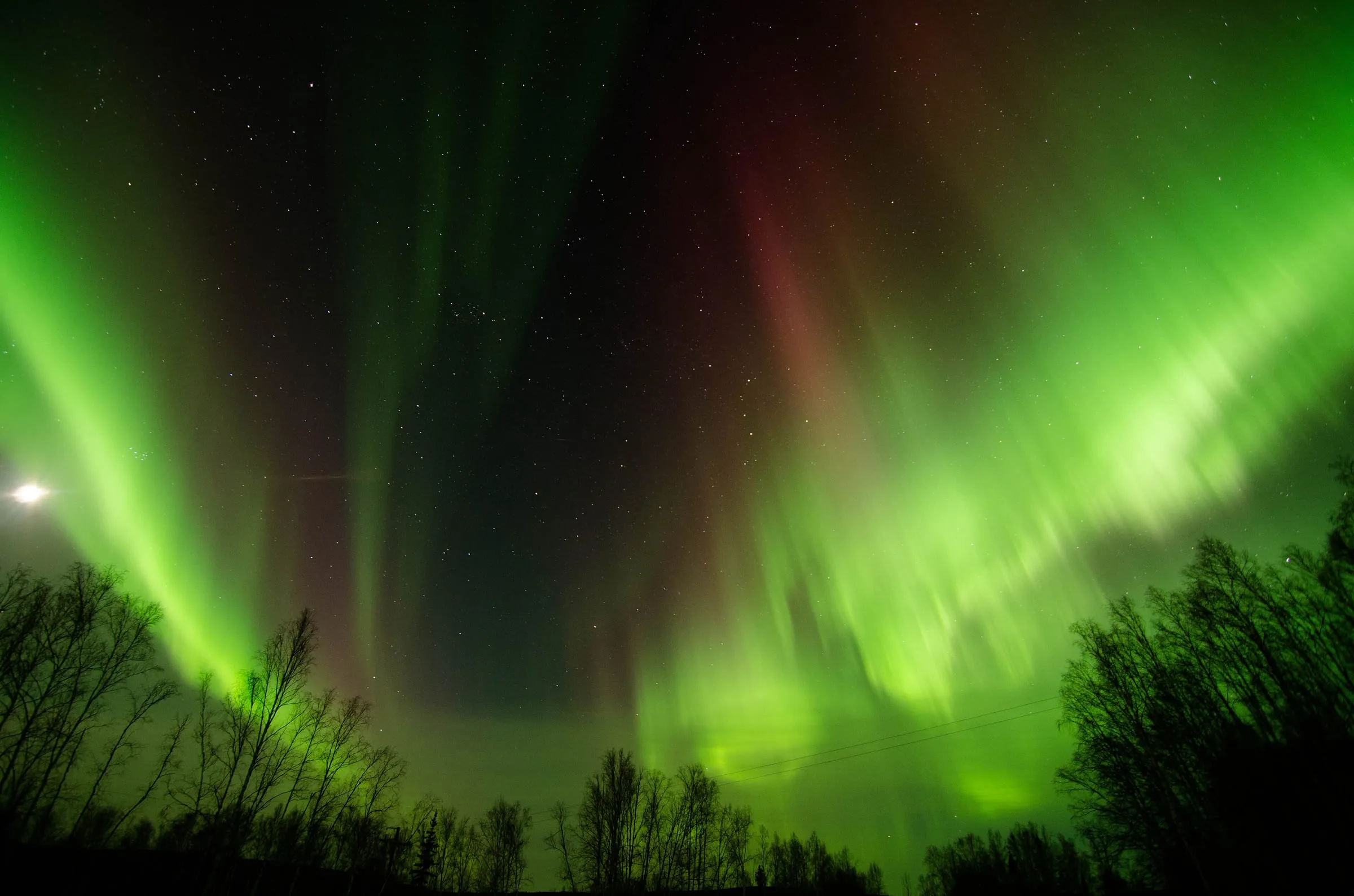
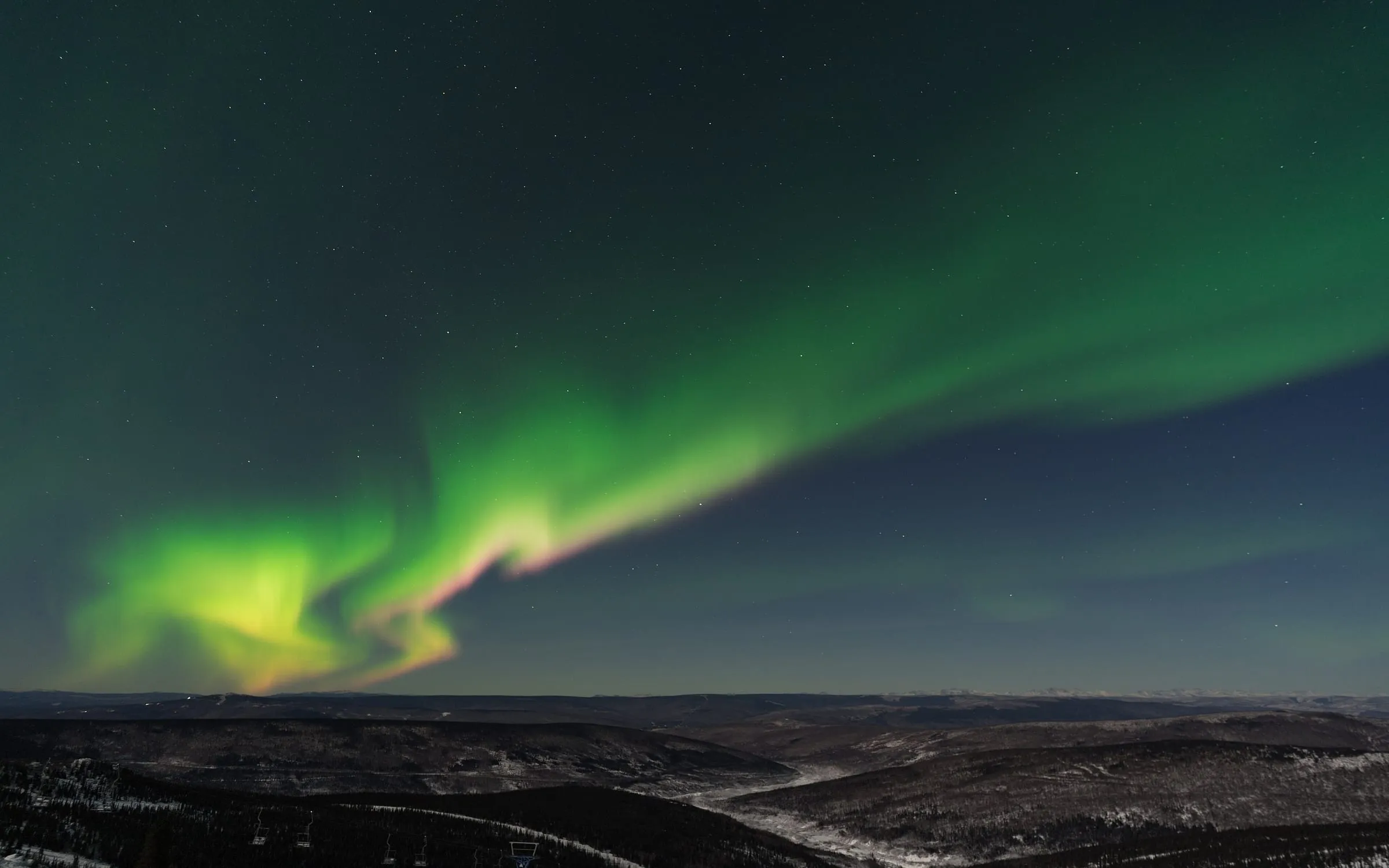
Expect the eye to see less color than a camera. “There is often more red aurora in photos than you can see with the unaided eye,” the Institute says, and to the eye “The overall impression is a greenish-whitish glow.” The photograph at the top of this page is a long exposure, which, in the caption it was published with, turned the sky “a brilliant green”.
Where to stand matters as much. The Institute tells visitors “to watch from a hill away from city lights with a clear view of the horizon, since the aurora can occur in any part of the sky”; our best time to see the northern lights guide lists the hills it recommends, with the drive from downtown to three of them. And dress for hours of standing still: January’s normal low at Fairbanks International Airport is -17.2°F, by NOAA’s 1991–2020 normals. Our what to wear in Fairbanks in winter guide covers the layers, and renting a car and winter driving the roads out to the hills at night.
What a forecast cannot do
“Scientists can predict when and where there will be aurora,” the Institute says, “but with less confidence than they can predict the regular weather.” Read together, the Kp, the cloud cover and the moon tell you which nights are worth staying up for. None of them tells you the aurora will come, and on a clear night with a low Kp it still may.