

Come between about 21 August and 21 April, the University of Alaska Fairbanks Geophysical Institute’s aurora season for Fairbanks. If you can choose, aim for September or March, near the equinoxes, when the Institute finds the odds over Interior Alaska about twice as high as at the solstices. In winter, be out from 9 p.m. to 3 a.m. AKST, the Institute’s likeliest hours for a strong display; give yourself at least three nights, and pick dates near a new moon if you are photographing. Nothing makes a sighting certain: a clear sky and darkness decide each night.
This page is for anyone choosing dates for the northern lights in Fairbanks: the winter visitor who comes for the aurora, the visitor weighing September against March, and the summer visitor wondering whether late August can catch it. The guidance is the Geophysical Institute’s, quoted as it stood on 23 November 2026. Daylight, the moon’s phases, the equinoxes and the solstice are the US Naval Observatory’s, converted to Alaska time; the cold is NOAA’s 1991–2020 normals at Fairbanks International Airport, averages rather than a forecast. Every clock time on this page is Alaska time: Alaska Standard Time (AKST, UTC-9) until 2:00 a.m. on 14 March 2027, and Alaska Daylight Time (AKDT, UTC-8) from then until 2:00 a.m. on 7 November 2027.
The season: about 21 August to 21 April
The Geophysical Institute puts the town’s aurora viewing “season” at “roughly August 21 to April 21”. Between those dates, it says, “if the weather is clear and you stay for at least three nights, it’s highly likely (though never certain!) that you will see the aurora.” Explore Fairbanks, the visitor bureau, gives the same dates.
Outside them, the problem is light, not the aurora. “Although the sun does set to varying degrees in Fairbanks between April 22 and August 20,” the Institute says, “the sky doesn’t get dark enough to see the aurora even if it was a spectacular display.” For some time after 21 April and before 20 August there are two “shoulder seasons”, when the sky is dark enough for very brief glimpses in twilight, and the Institute recommends avoiding them when you plan a trip.
Chena Hot Springs Resort states its own aurora season two ways, “Late Aug to mid April” on its activities page and “September through March” on its aurora page. The Institute’s dates are the ones to plan by.
So from late April to 20 August, outside those brief twilight glimpses, a visitor will not see the aurora from Fairbanks. Summer here is for the long days, the riverboat and the gold dredge: our Fairbanks summer tours page has them.
Which month: September or March, if the sky allows
The Institute’s answer to which month is the equinoxes. Auroral activity, it says, tends to be more intense around the fall and spring equinoxes than at the summer and winter solstices, a tendency known as the Russell-McPherron effect, so “the statistical likelihood of seeing aurora over Interior Alaska is roughly twice as high on the equinox as it is at solstice.” Clear skies are the other half: “the clearer the sky, the more aurora that can be seen”, and the continental parts of Alaska, Russia and western Canada under the auroral zone have, statistically, the clearest skies. Its conclusion: aurora viewing “may be best in locations with clear skies and around the spring (March) or fall (September) equinox.”
The Naval Observatory puts the March equinox at 12:25 p.m. AKDT on 20 March 2027 and the September equinox at 10:02 p.m. AKDT on 22 September 2027. The December solstice, the shortest day of the year, falls at 11:50 a.m. AKST on 21 December 2026.
The months trade darkness against cold. Daylight below is the Naval Observatory’s for Fairbanks in Alaska time, the time any part of the sun is above the horizon; the lows are NOAA’s 1991–2020 normals at Fairbanks International Airport. For the full year, highs and snowfall included, see our Fairbanks weather and daylight by month guide.
| Month | Daylight on the 1st | Daylight on the 15th | Normal low | Days with a low at or below 0°F |
|---|---|---|---|---|
| December 2026 | 4 hours 40 minutes | 3 hours 48 minutes | -13.0°F | 25.6 |
| January 2027 | 4 hours 2 minutes | 5 hours 9 minutes | -17.2°F | 25.7 |
| February 2027 | 6 hours 57 minutes | 8 hours 33 minutes | -11.2°F | 21.2 |
| March 2027 | 10 hours 8 minutes | 11 hours 42 minutes | -3.4°F | 18.2 |
| April 2027, to the 21st | 13 hours 37 minutes | 15 hours 12 minutes | 21.7°F | 2.0 |
| September 2027 | 14 hours 38 minutes | 13 hours 4 minutes | 36.2°F | 0.0 |
| October 2027 | 11 hours 18 minutes | 9 hours 45 minutes | 18.4°F | 2.8 |
| November 2027 | 7 hours 50 minutes | 6 hours 17 minutes | -4.1°F | 18.2 |
- September, for the fall equinox without the deep cold. The normal low is 36.2°F, and on average no day in the month has a low at or below 0°F. The nights lengthen fast: the sun is up 14 hours 38 minutes on 1 September 2027 and 11 hours 18 minutes on 1 October.
- March, for the spring equinox in winter. The worst of the cold is past, with a normal low of -3.4°F against January’s -17.2°F, though the low still falls to 0°F or below on 18.2 days of the month, and the normals bring 6.5 inches of snow. Daylight runs from 10 hours 8 minutes on 1 March 2027 to 13 hours 37 minutes on 1 April, and the clocks move forward an hour on 14 March. For what else there is to do on a winter trip, see our things to do in Fairbanks in winter.
- December and January, for the longest nights. The sun is up only 3 hours 42 minutes on 20 to 22 December 2026 and 4 hours 2 minutes on 1 January 2027, the longest nights of the season. That is the solstice, though, when the Institute’s odds are about half the equinoxes’, and the cold is at its deepest: January’s normal low is -17.2°F, with 25.7 days a month at or below 0°F.
- October, November, February and April sit between. October’s normal low is 18.4°F and February’s -11.2°F. April’s last nights of the season are short: on 21 April 2027 the sun is up 15 hours 53 minutes, with a normal low for the month of 21.7°F.
- Late August opens the season. On 21 August 2027 the sun is up 15 hours 52 minutes, and August’s normal low is 47.6°F: short nights, but no cold to speak of.
If you can choose freely, we would take one of the equinox months, and let the rest of the trip decide which: September for mild nights, March for snow with the cold easing.
The hour: 9 p.m. to 3 a.m.
“Although aurora occurs throughout the night,” the Institute says, “the best time to watch for the aurora is the three or four hours centered around midnight.” Active displays tend to grow more diffuse and fragmented later in the night, “which means that 9 p.m. to 3 a.m. is typically the time period with higher probability of seeing spectacular auroral displays over interior Alaska in winter.” In winter that is 9 p.m. to 3 a.m. AKST.
Darkness and a clear sky are both essential, so, in the Institute’s words, “the best time is determined by the weather and by the sunrise and sunset times.” In practice that means being out of town and away from lights by 9 p.m. and staying out past midnight, which is why the aurora tours on our Fairbanks northern lights tours page run late into the night.
The moon
The moon cuts both ways. “When the moon is full or close to full,” the Institute says, “the added ambient light may prevent you from seeing dim auroral features. However, this same effect also may enhance their colors.” For photographs it is plainer: “For photography enthusiasts, third-quarter or new moon phases are best”, since the aurora’s reflections on the ground get “washed out” when the moon is fuller. So a bright moon is no reason to cancel a trip, but if your dates are free, set them away from the full moon, and for photographs between a third quarter and the new moon that follows.
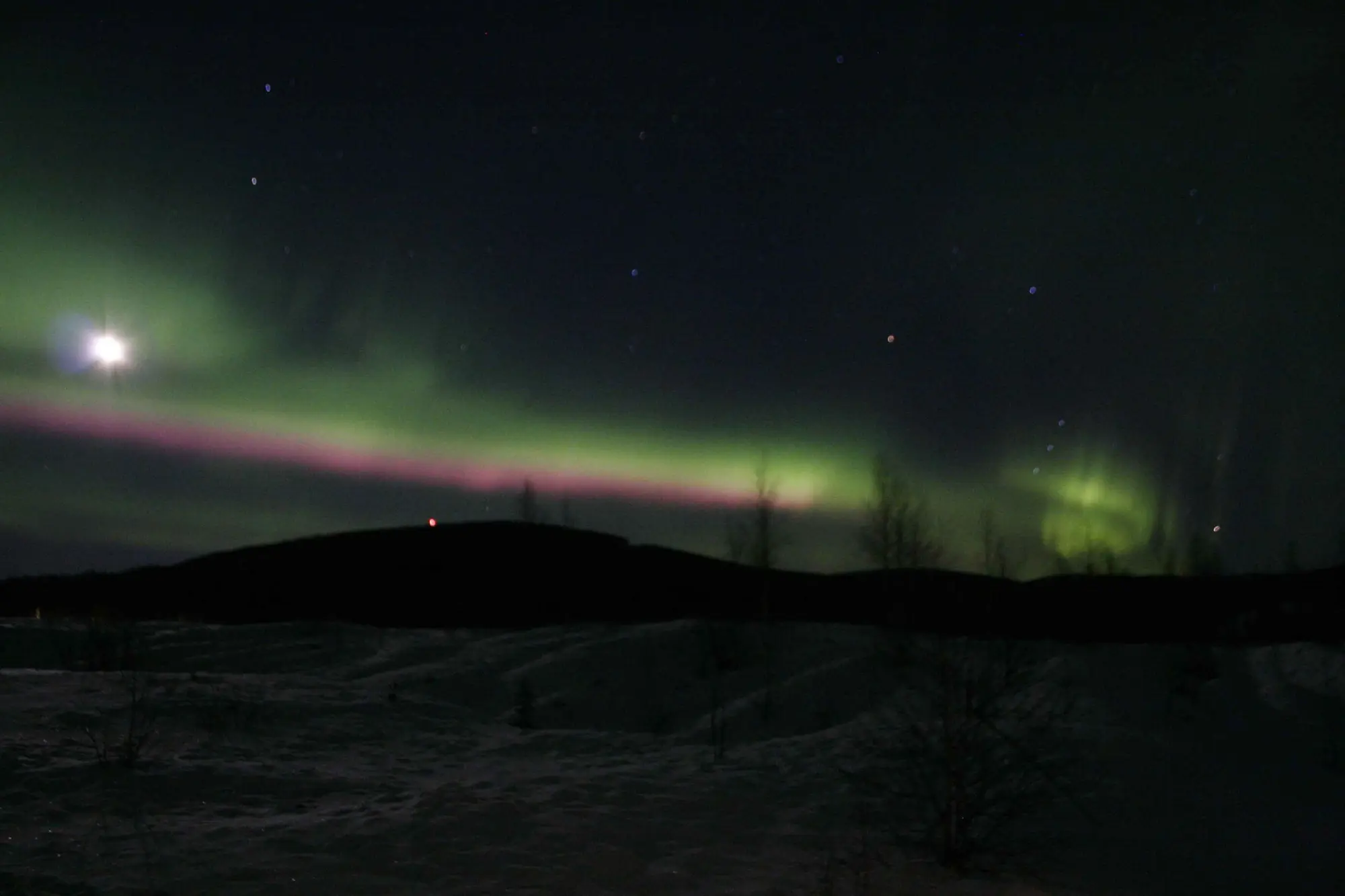
The photograph at the top of this page shows a bright moon beside a band of aurora low over a snowy hill in Alaska.
The phases below are the Naval Observatory’s, converted to Alaska time, from 25 November 2026 to the end of the season and through the fall of 2027. Its “last quarter” is the Institute’s third quarter.
| Third quarter | New moon | Full moon |
|---|---|---|
| 30 November 2026, 9:08 p.m. AKST | 8 December 2026, 3:52 p.m. AKST | 23 December 2026, 4:28 p.m. AKST |
| 30 December 2026, 9:59 a.m. AKST | 7 January 2027, 11:24 a.m. AKST | 22 January 2027, 3:17 a.m. AKST |
| 29 January 2027, 1:55 a.m. AKST | 6 February 2027, 6:56 a.m. AKST | 20 February 2027, 2:23 p.m. AKST |
| 27 February 2027, 8:16 p.m. AKST | 8 March 2027, 12:29 a.m. AKST | 22 March 2027, 2:44 a.m. AKDT |
| 29 March 2027, 4:54 p.m. AKDT | 6 April 2027, 3:51 p.m. AKDT | 20 April 2027, 2:27 p.m. AKDT |
| 24 August 2027, 6:27 p.m. AKDT | 31 August 2027, 9:41 a.m. AKDT | 15 September 2027, 3:03 p.m. AKDT |
| 23 September 2027, 2:20 a.m. AKDT | 29 September 2027, 6:36 p.m. AKDT | 15 October 2027, 5:47 a.m. AKDT |
| 22 October 2027, 9:29 a.m. AKDT | 29 October 2027, 5:36 a.m. AKDT | 13 November 2027, 6:26 p.m. AKST |
The new moon of 8 March 2027 falls just after midnight, so it belongs to the night of 7 to 8 March. The winter’s phases week by week, beside the daylight, the cold and the events, are on our northern lights calendar for 2026–2027.
Where to watch from
The Institute’s advice for visitors is to “watch from a hill away from city lights with a clear view of the horizon, since the aurora can occur in any part of the sky.” The sites it recommends around Fairbanks include the Chena Lakes Recreation Area, the Tanana Lakes Recreation Area just south of town, Cleary Summit, Ester, Wickersham and Murphy Domes, Haystack Mountain on the Elliott Highway, and turnouts along the Elliott, Steese and Parks Highways and Chena Hot Springs Road.
From the Morris Thompson Cultural and Visitors Center downtown, Cleary Summit on the Steese Highway is about 20 miles and 30 minutes by car, the Chena Lakes Recreation Area about 19 miles and 30 minutes, and the road below the summit of Murphy Dome about 27 miles and 1 hour 20 minutes. Those are times for a clear summer road; snow and ice add to them.
The Institute warns about the cold too. Of “the extremely cold winter weather” it says: “In those conditions, small problems may become disasters in remote areas. If you are aurora hunting at cold temperatures, please be prepared!” Our what to wear in Fairbanks in winter guide covers the layers, and our renting a car and winter driving guide the roads. If you would rather wait in the warm, our page on aurora viewing lodges and cabins compares the heated cabins on the ridges outside town.
How many nights, and the forecast
The Institute’s three nights are a floor, not a guarantee. Of the auroral oval, the band where the aurora most often occurs, it says that in “dark and clear conditions” a visitor who stays “3–7 days” will “most likely see the aurora.” Each night added is another chance at a clear one; our Fairbanks itinerary builds the nights around that.
The forecasts you will see quote the Kp index, a global three-hour measure of geomagnetic activity from 0 to 9. Asked whether Kp can forecast the aurora in Fairbanks, the Institute answers “Yes and no”: inside the auroral oval, it says, Kp is less relevant, “since even when global activity is low, auroral activity can be high.” How to read the forecast is on our Fairbanks aurora forecast guide.
Booking the nights
Once you have the dates, our Fairbanks northern lights tours page compares the aurora chases and photography nights, with the terms each operator sets for a cloudy night, and our where to stay in Fairbanks guide weighs town against the hills. Viator’s full list of what can be booked in Fairbanks is at the end of this page: check where each trip starts and whether it picks you up.


