This page is for anyone choosing a month for Fairbanks: the winter visitor after the aurora, who needs the dark and gets the cold with it, and the summer visitor or cruise-tour passenger, who gets long, mild days and, until late August, almost no aurora. From November to March every month’s normal low at the airport is below 0°F, and January’s is -17.2°F; Fairbanks has 3 hours 42 minutes of daylight from 20 to 22 December 2026. July’s normal high is 72.7°F, and there are 21 hours 49 minutes of daylight from 19 to 22 June 2027.
The temperatures, snow and precipitation are the 1991–2020 normals that NOAA’s National Centers for Environmental Information (NCEI) publish for the weather station at Fairbanks International Airport: each is a normal for those 30 years, not a forecast. The records are from NWS Fairbanks, the National Weather Service’s Fairbanks office. Daylight, sunrise and sunset, the solstices and the equinoxes are the US Naval Observatory’s (USNO) for Fairbanks. Every clock time on this page is Alaska time: Alaska Standard Time (AKST, UTC-9) until 2:00 a.m. on 14 March 2027, and Alaska Daylight Time (AKDT, UTC-8) from then until 2:00 a.m. on 7 November 2027, the second Sunday of March and the first Sunday of November under the federal rule.
Fairbanks weather by month
Each figure is a 1991–2020 normal at Fairbanks International Airport. The normal high is the average of a month’s daily highs, and a day counts in the zero column when its low is 0°F or colder.
| Month | Normal high | Normal low | Days with a low at or below 0°F | Snowfall | Precipitation |
|---|---|---|---|---|---|
| January | 0.6°F | -17.2°F | 25.7 | 10.2 in | 0.61 in |
| February | 11.6°F | -11.2°F | 21.2 | 10.0 in | 0.52 in |
| March | 24.9°F | -3.4°F | 18.2 | 6.5 in | 0.40 in |
| April | 45.6°F | 21.7°F | 2.0 | 3.1 in | 0.34 in |
| May | 62.1°F | 38.6°F | 0.0 | 0.9 in | 0.54 in |
| June | 71.8°F | 50.2°F | 0.0 | 0.0 in | 1.48 in |
| July | 72.7°F | 53.1°F | 0.0 | 0.0 in | 2.26 in |
| August | 66.4°F | 47.6°F | 0.0 | A trace | 2.10 in |
| September | 55.3°F | 36.2°F | 0.0 | 2.3 in | 1.35 in |
| October | 34.1°F | 18.4°F | 2.8 | 8.2 in | 0.76 in |
| November | 12.3°F | -4.1°F | 18.2 | 12.5 in | 0.74 in |
| December | 4.3°F | -13.0°F | 25.6 | 10.9 in | 0.57 in |
August’s snowfall is a trace: NOAA’s figure is an amount above zero that rounds to 0.0 inches. The snowiest month is November, at 12.5 inches. The wettest are July, at 2.26 inches, and August, at 2.10; the driest is April, at 0.34 inches.
How cold Fairbanks gets in winter
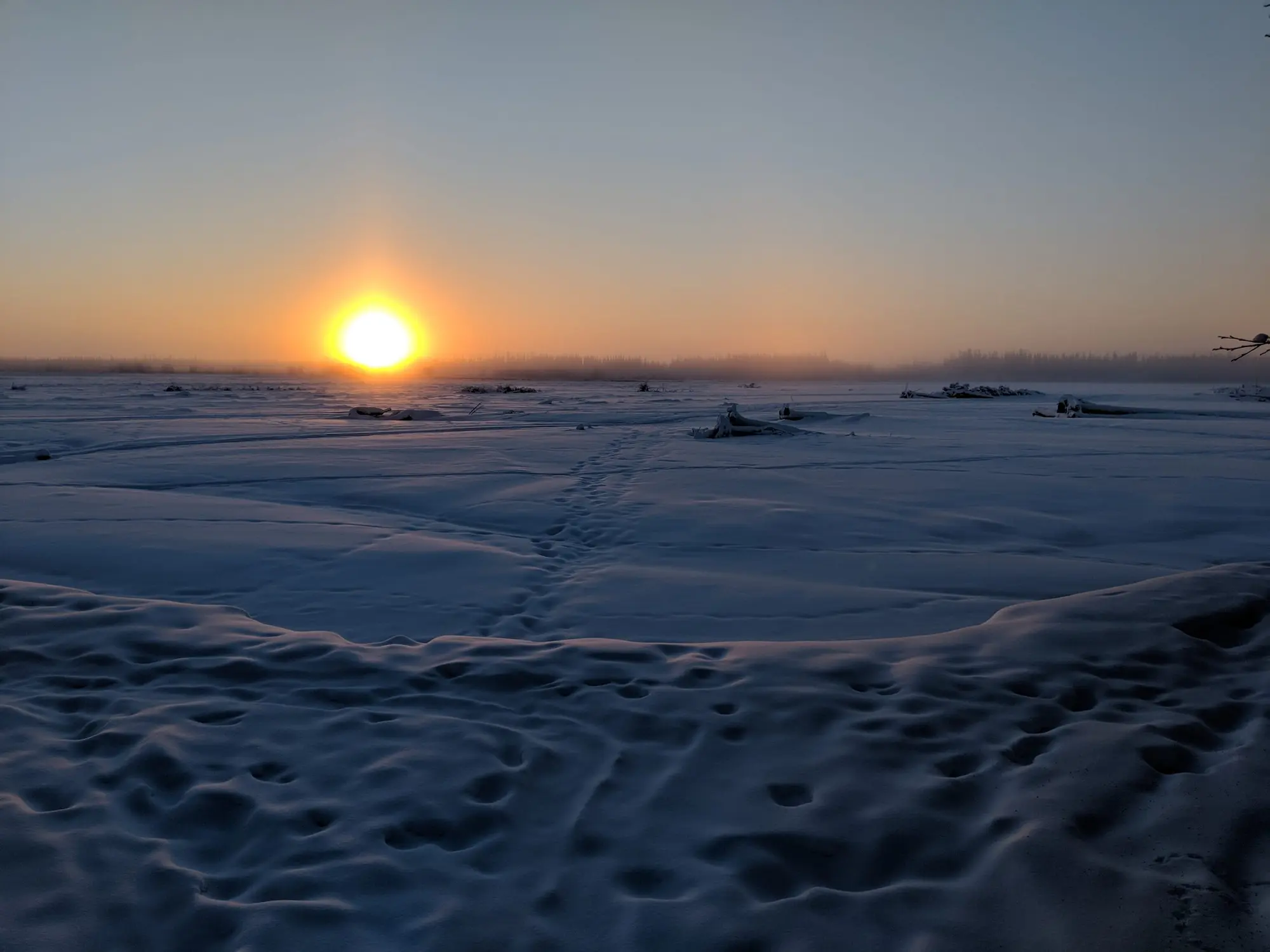
From November to March the normal low is below 0°F in every month, and the normal high stays below freezing too: 12.3°F in November, 4.3°F in December, 0.6°F in January, 11.6°F in February and 24.9°F in March. A normal low is an average, so many nights of the month run colder. In January the low reaches 0°F or below on 25.7 days of 31, and the high stays at or below 32°F on 29.8.
The records go much lower. On NWS Fairbanks’s daily record sheets, kept since 1904, every date from 1 December to 28 February has a record low of -46°F or colder. The coldest is -66°F, on 14 January 1934; December’s is -62°F, on 28 and 29 December 1961, and February’s -58°F, on 2 February 1993 and 3 February 1947. The sheets were last updated in May 2016, so a record set since then is not on them, and the office calls its record data preliminary: they have not been through NCEI’s final quality control.
How to dress for it, and where to rent a parka, is on what to wear in Fairbanks in winter; the roads, studded tires and a rental car in the cold are on renting a car and winter driving in Fairbanks.
Daylight by month
Daylight here is the Naval Observatory’s for Fairbanks: the total time that any part of the sun is above the horizon. It runs from 3 hours 42 minutes around the December solstice to 21 hours 49 minutes around the June one. From February to May and from July to November it changes by more than three hours between the first and the last day of the month. The table runs through the twelve months from December 2026.
| Month | On the 1st | On the 15th | On the last day |
|---|---|---|---|
| December 2026 | 4 hours 40 minutes | 3 hours 48 minutes | 3 hours 58 minutes |
| January 2027 | 4 hours 2 minutes | 5 hours 9 minutes | 6 hours 51 minutes |
| February 2027 | 6 hours 57 minutes | 8 hours 33 minutes | 10 hours 1 minute |
| March 2027 | 10 hours 8 minutes | 11 hours 42 minutes | 13 hours 30 minutes |
| April 2027 | 13 hours 37 minutes | 15 hours 12 minutes | 16 hours 56 minutes |
| May 2027 | 17 hours 3 minutes | 18 hours 41 minutes | 20 hours 29 minutes |
| June 2027 | 20 hours 35 minutes | 21 hours 41 minutes | 21 hours 29 minutes |
| July 2027 | 21 hours 25 minutes | 20 hours 6 minutes | 18 hours 17 minutes |
| August 2027 | 18 hours 10 minutes | 16 hours 33 minutes | 14 hours 44 minutes |
| September 2027 | 14 hours 38 minutes | 13 hours 4 minutes | 11 hours 25 minutes |
| October 2027 | 11 hours 18 minutes | 9 hours 45 minutes | 7 hours 57 minutes |
| November 2027 | 7 hours 50 minutes | 6 hours 17 minutes | 4 hours 47 minutes |
The shortest days
The December solstice falls at 11:50 a.m. AKST on 21 December 2026, and Fairbanks has 3 hours 42 minutes of daylight on 20, 21 and 22 December 2026. On the 21st the sun rises at 10:58 a.m. and sets at 2:40 p.m. AKST, and civil twilight, the light before sunrise and after sunset, runs from 9:33 a.m. to 4:05 p.m. AKST.
The longest days
The June solstice falls at 6:11 a.m. AKDT on 21 June 2027, and Fairbanks has 21 hours 49 minutes of daylight from 19 to 22 June 2027. On 21 June the sun sets at 12:47 a.m. AKDT and rises again at 2:58 a.m., and by the Naval Observatory it stays above the twilight limit all day and night, so the sky does not get dark.
The equinoxes
The March equinox falls at 12:25 p.m. AKDT on 20 March 2027, when Fairbanks has 12 hours 16 minutes of daylight, and the September equinox at 10:02 p.m. AKDT on 22 September 2027, with 12 hours 18 minutes. Daylight passes 12 hours on 18 March 2027 and drops below it on 25 September.
The dark season for the aurora
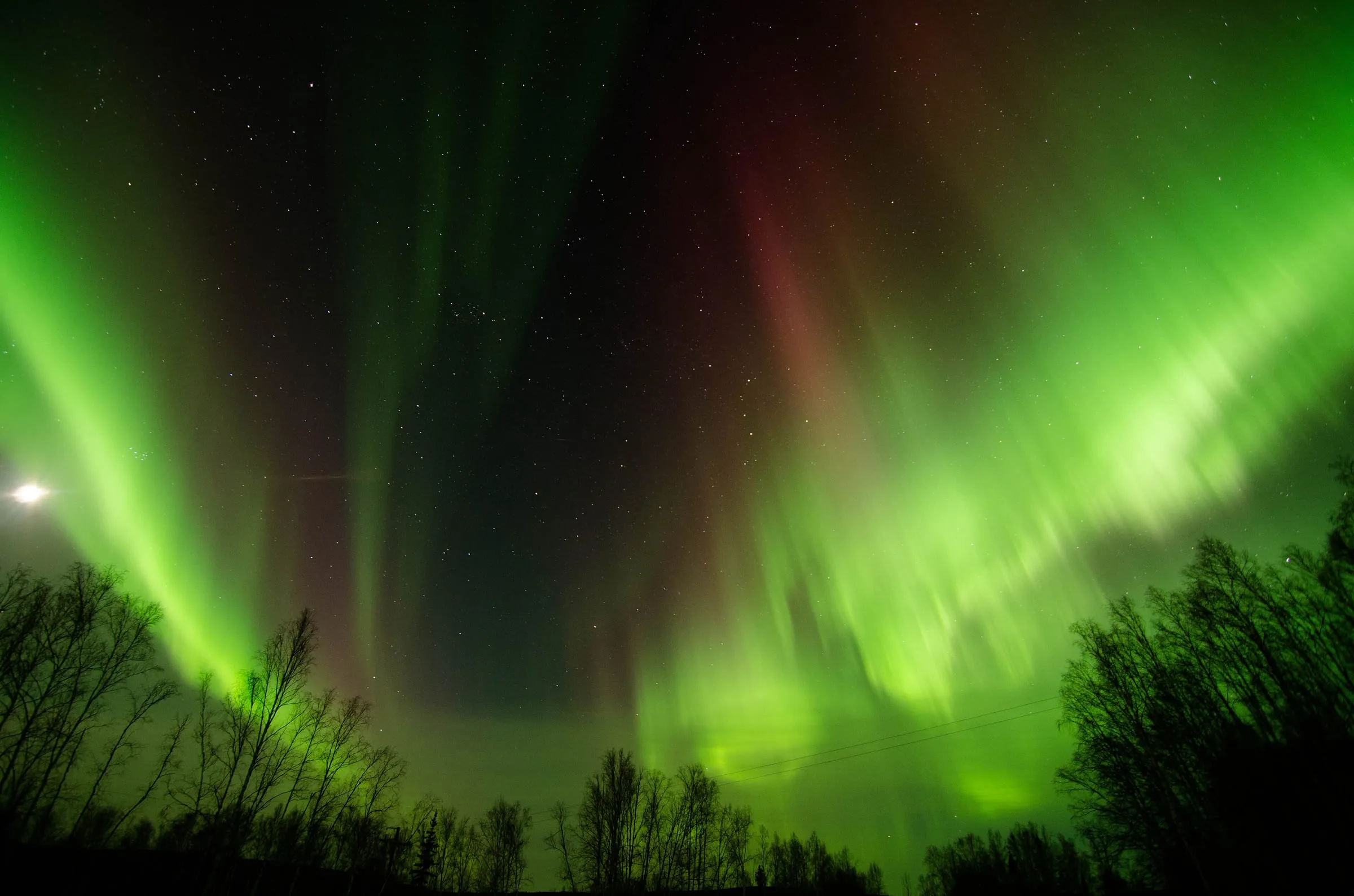
The Geophysical Institute at the University of Alaska Fairbanks puts the aurora viewing season at Fairbanks at “roughly August 21 to April 21”, and outside it the light wins: “Although the sun does set to varying degrees in Fairbanks between April 22 and August 20, the sky doesn’t get dark enough to see the aurora even if it was a spectacular display.” It notes two “shoulder seasons”, for some time after 21 April and before 20 August, when the sky may be dark enough to see the aurora “for very brief periods of time during twilight”, and it advises avoiding them and visiting between 21 August and 21 April. Within the season no night is promised, and the Institute calls partially clear skies a requirement. Which months and hours give the best odds is on the best time to see the northern lights in Fairbanks, the winter’s new moons week by week on the northern lights calendar, and how to read the Institute’s forecast on the Fairbanks aurora forecast.
Fairbanks month by month
Each month below gives the airport’s normals and the daylight from the tables above, with the counts of days that matter for that month.
January
The coldest month: a normal high of 0.6°F and a normal low of -17.2°F, with a low at or below 0°F on 25.7 days and the high at or below 32°F on 29.8. Snowfall is 10.2 inches, and an inch or more lies on the ground every day. The coldest record on NWS Fairbanks’s sheets, -66°F, is from 14 January 1934. The light comes back fast: 4 hours 2 minutes on 1 January 2027 and 6 hours 51 minutes on the 31st, 2 hours 49 minutes more.
February
Still deep winter, with more light. The normal high is 11.6°F and the normal low -11.2°F, with a low at or below 0°F on 21.2 days and 10.0 inches of snow. Daylight grows from 6 hours 57 minutes on 1 February 2027 to 10 hours 1 minute on the 28th.
March
Cold nights and long, bright days. A low at or below 0°F comes on 18.2 days, the same count as November, and the normal low is -3.4°F against November’s -4.1°F. But the normal high climbs to 24.9°F, and daylight grows from 10 hours 8 minutes on 1 March 2027 to 13 hours 30 minutes on the 31st, where November runs from 7 hours 50 minutes down to 4 hours 47 minutes. Snow lies on the ground every day, with 6.5 inches more falling. Clocks go forward an hour at 2:00 a.m. AKST on 14 March 2027, and the equinox falls at 12:25 p.m. AKDT on 20 March. The Geophysical Institute says aurora viewing “may be best in locations with clear skies and around the spring (March) or fall (September) equinox.” Winter’s late events are on things to do in Fairbanks in winter.
April
Spring arrives. The normal high reaches 45.6°F and the low 21.7°F, a low at or below 0°F comes on only 2.0 days, and April is the driest month, with 0.34 inches of precipitation and 3.1 inches of snow. Snow still lies on the ground on 21.9 days. Daylight runs from 13 hours 37 minutes on 1 April 2027 to 16 hours 56 minutes on the 30th, and the Geophysical Institute’s aurora season ends roughly 21 April.
May
Mild days, with a frost now and then. The normal high is 62.1°F and the low 38.6°F; the low reaches 32°F or below on 6.2 days, the normal snowfall is 0.9 inches, and an inch or more is on the ground on 1.0 day. Daylight runs from 17 hours 3 minutes on 1 May 2027 to 20 hours 29 minutes on the 31st.
June
Warm, and light around the clock at the solstice. The normal high is 71.8°F and the low 50.2°F; the high reaches 70°F or more on 18.4 days and 80°F or more on 4.6. Precipitation rises to 1.48 inches. Daylight peaks at 21 hours 49 minutes from 19 to 22 June 2027, and on 21 June the sun is down only from 12:47 a.m. to 2:58 a.m. AKDT.
July
The warmest month, and the wettest. The normal high is 72.7°F and the low 53.1°F, with a high of 70°F or more on 21.3 days and 80°F or more on 5.4. Precipitation is 2.26 inches, with a tenth of an inch or more on 5.5 days. Daylight falls from 21 hours 25 minutes on 1 July 2027 to 18 hours 17 minutes on the 31st. What runs in the long days is on Fairbanks summer tours.
August
Cooler and still wet. The normal high is 66.4°F and the low 47.6°F, with 2.10 inches of precipitation and a tenth of an inch or more on 6.1 days, the most of any month. Daylight drops from 18 hours 10 minutes on 1 August 2027 to 14 hours 44 minutes on the 31st, and the Geophysical Institute’s aurora season opens roughly 21 August.
September
A short fall. The normal high is 55.3°F and the low 36.2°F; the low reaches 32°F or below on 9.3 days, and the normal snowfall is 2.3 inches. Daylight falls from 14 hours 38 minutes on 1 September 2027 to 11 hours 25 minutes on the 30th, past the equinox at 10:02 p.m. AKDT on 22 September.
October
Winter starts. The normal high falls to 34.1°F and the low to 18.4°F; the high stays at or below 32°F on 14.2 days, and 8.2 inches of snow falls, with an inch or more on the ground on 15.2 days. Daylight drops from 11 hours 18 minutes on 1 October 2027 to 7 hours 57 minutes on the 31st.
November
The snowiest month. The normal high is 12.3°F and the low -4.1°F, with a low at or below 0°F on 18.2 days and the high at or below 32°F on 27.9; 12.5 inches of snow falls, and an inch or more lies on the ground on 29.3 days. Daylight falls from 7 hours 50 minutes on 1 November 2027 to 4 hours 47 minutes on the 30th, and Alaska returns to standard time at 2:00 a.m. AKDT on 7 November 2027.
December
The darkest month, and the second coldest. The normal high is 4.3°F and the low -13.0°F, with a low at or below 0°F on 25.6 days and the high at or below 32°F on 30.1; 10.9 inches of snow falls, and snow lies on the ground every day. Daylight runs from 4 hours 40 minutes on 1 December 2026 down to 3 hours 42 minutes from 20 to 22 December and back to 3 hours 58 minutes on the 31st. With the sun up from 10:58 a.m. to 2:40 p.m. AKST on 21 December, a day trip out of town spends much of its time in the dark.