Fairbanks has two places to begin with the Alaska Native peoples of the Interior: the University of Alaska Museum of the North, on the university’s Troth Yeddha’ Campus at 1962 Yukon Drive, and the Morris Thompson Cultural and Visitors Center downtown at 101 Dunkel Street, free and open all year. This page is for both of our readers: the winter aurora visitor with a day to fill between nights out, and the summer visitor or cruise-tour passenger with a day in town. It gives each place’s hours and prices, dated, how to get there, and the town’s two big Alaska Native gatherings, the Festival of Native Arts in February and the World Eskimo-Indian Olympics in July. Every clock time on this page is Alaska Time: AKST (UTC-9) until 14 March 2027 and again from 7 November 2027, AKDT (UTC-8) in between.
Whose land this is
Fairbanks stands on the traditional lands of the Dena. The Morris Thompson Center begins its acknowledgment with them: “We respectfully acknowledge the Dena people on whose traditional lands we reside.” The University of Alaska Fairbanks says the same of its campus: “In Fairbanks, our Troth Yeddha’ campus is located on the ancestral lands of the Dena people of the lower Tanana River.”
Troth Yeddha’ is the Dena name of the ridge the university stands on. The university’s Troth Yeddha’ Initiative, drawing on its Alaska Native Language Center, gives the name’s story: the ridge “was called Troth Yeddha’ (sometimes spelled Troth Yetth) by the Lower Tanana Dene (or Athabascans).” Troth is the plant Hedysarum alpinum, the wild potato, whose roots were the most important vegetable food of the Alaska Athabascans, and yeddha’ means “its ridge, its hill.” Troth still grows on the flood plains between the campus and the Tanana River.
Tanana Chiefs Conference (TCC), the tribal consortium of the Interior, opens its own account of itself with its name in the language:
We are organized as Dena’ Nena’ Henash or “Our Land Speaks”; an Alaska Native non-profit corporation, charged with advancing Tribal self-determination and enhancing regional Native unity.
TCC counts 42 members, including 39 villages and 37 federally recognized tribes, across a region of 235,000 square miles of Interior Alaska, about 37 percent of the state (its About page, last changed 20 April 2022). It was formally organized in 1962, and it traces its history back more than a hundred years, to the tribal chiefs of the region who banded together to protect their land rights.
Denakkanaaga, Inc. is the voice of the Interior’s Native Elders (“Denakkanaaga means ‘Our People Speak’ in Koyukon-Athabascan,” in its own words), and its office is at 101 Dunkel Street, the Morris Thompson Center’s address. With the center, TCC, the university and the borough’s school district it runs monthly cultural programs on seasonal themes, led by respected Elders and leaders of the Native community.
The University of Alaska Museum of the North
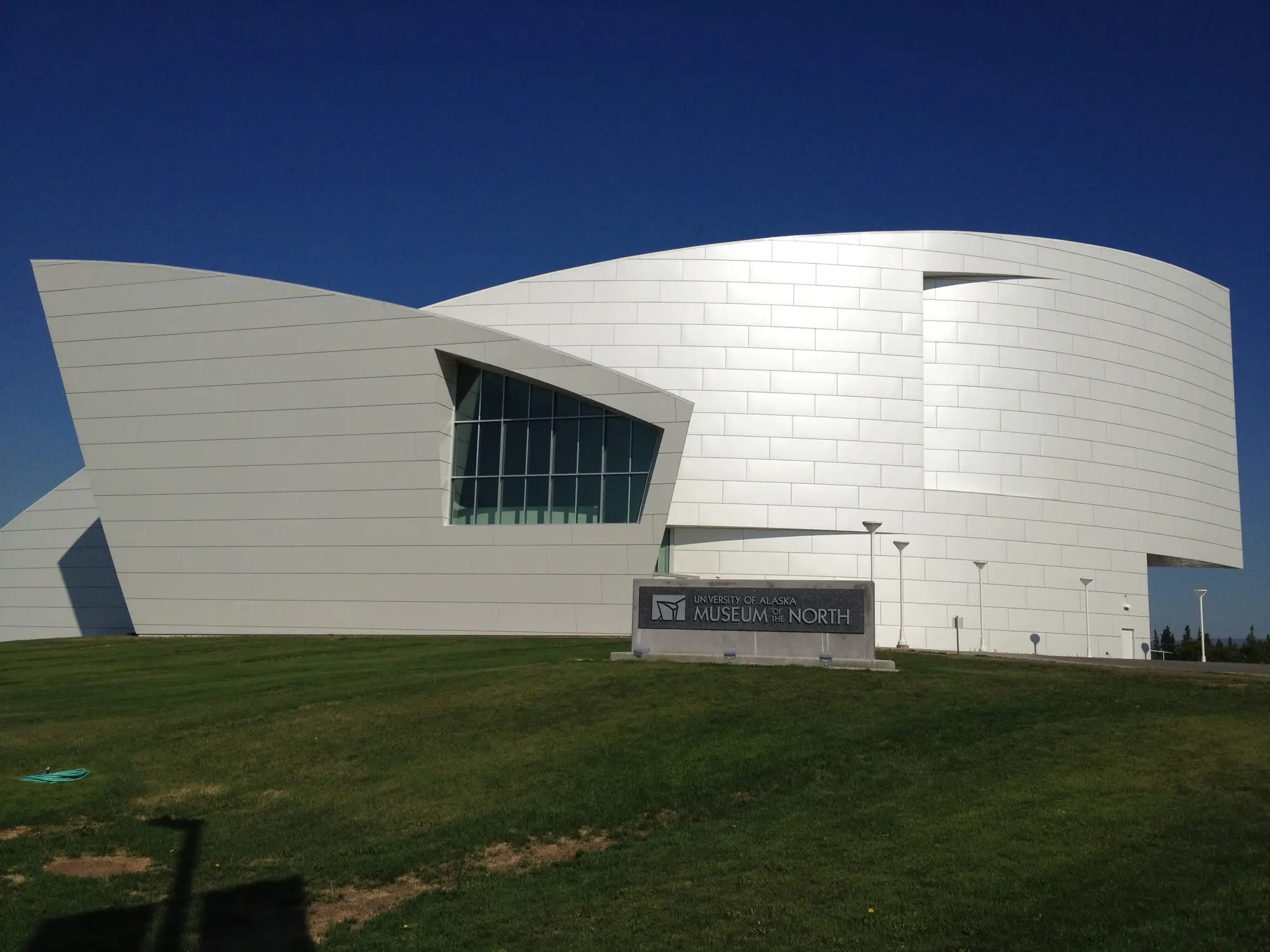
The museum stands on the Troth Yeddha’ Campus at 1962 Yukon Drive, about 6 miles and 15 minutes by car from the Morris Thompson Center downtown and about 5 miles and 15 minutes from Fairbanks International Airport, on a clear road with no traffic; on snow and ice the drive takes longer. The university calls it the only research and teaching museum in Alaska, and its collections hold 2.5 million artifacts and specimens in 10 disciplines, from archaeology and ethnology to mammals, birds and fine arts. What is on show:
- The Gallery of Alaska, the main exhibition area, in five regional galleries for Alaska’s major ecological regions, each with its natural and cultural history. Otto, a brown bear 8 feet 9 inches tall, greets visitors, with the History of Alaska exhibit beside him; a woolly mammoth’s skull and tusks stand at the entrance to the Interior Gallery; and the gallery holds Blue Babe, a mummified steppe bison almost 50,000 years old, and what the museum calls the state’s largest public display of gold.
- The Rose Berry Alaska Art Gallery: 2,000 years of Alaska art, from ancient ivory carvings to contemporary painting and sculpture.
- The Place Where You Go to Listen, a sound and light installation that changes with the real-time positions of the sun and moon, with seismic activity and with the aurora.
- Films every day, a café, and the Museum Store, which sells Alaska Native artwork, jewelry and books; its proceeds support the museum.
The museum’s free mobile app, for Android and iPhone, tours the galleries from your phone. One thing you will not see: on 23 November 2026 the museum said Bus 142, the bus of Christopher McCandless’s story, was in offsite storage while funds are raised for an outdoor exhibition site.
Hours and admission
The museum’s hours, as it listed them on 23 November 2026, with the note that hours are subject to change:
| 1 September to 31 May | 1 June to 31 August | |
|---|---|---|
| Open | Every day, 9 a.m. to 5:30 p.m. | Every day, 9 a.m. to 7 p.m. AKDT |
| Admission sales end and doors close | 5 p.m. | 6:30 p.m. AKDT |
| Closed | 26 November 2026 (Thanksgiving), 25 December 2026 and 1 January 2027 | No closed days listed |
Its tickets the same day, with no tax or fee listed beside them:
| Ticket | Museum | Museum and a planetarium show |
|---|---|---|
| Adult, 18 to 64 | $23 | $32 |
| Senior, 65 and over | $20 | $29 |
| Youth, 6 to 17 | $15 | $20 |
| Alaska resident, with ID | $17 | $26 |
| Military and veteran, with ID | $17 | $26 |
Children 5 and under, University of Alaska staff, faculty and students, and holders of an EBT card (Museums for All) get into the museum free, and a group of 8 or more pays $18 a person.
The planetarium
The Walt and Marita Babula Planetarium is a 65-seat dome theater inside the museum, made with the university’s Geophysical Institute. Each show is a fulldome film followed by a live tour of the night sky, 45 minutes in all. On 23 November 2026 the museum listed shows every day at 1, 2, 3 and 4 p.m. Alaska time, and two more on Sundays at 10 and 11 a.m.; its aurora show, Aurora: Lights of Wonder, ran at 1 and 3 p.m. and at 10 a.m. on Sundays. On Saturdays at 10 and 11 a.m. it ran 30-minute family matinees, with no live part, at $5 a show for any age.
A show on its own is $12 for adults 18 and over and $8 for ages 3 to 17, with no tax or fee listed beside these or the matinee price, and needs no museum ticket; with the museum, the combination ticket above costs less than the two apart. Show tickets are sold in person at the museum’s front desk only, sales end 5 minutes before each show, there is no late entry, and the museum does not recommend the shows for children under 5. For the real aurora, our best time to see the northern lights page has the season and the hours.
Getting there and parking
By car, the museum is about 6 miles and 15 minutes from downtown and about 5 miles and 15 minutes from the airport, on a clear road. Visitor parking is in the museum’s lot beside the building, lot 9J on the university’s parking map. UAF charges $1.75 an hour or $7 a day there, and parking is free after 5 p.m. and on weekends; pay at a kiosk in the lot, which takes cash, coins and credit cards. Winter driving, and renting a car to do it, are on our renting a car and winter driving page.
By bus, the borough’s MACS Blue Line has a stop named UAF Museum, and the museum names the Red and Yellow Lines as serving the campus too; the Yellow Line also stops at the airport. Every MACS line runs Monday through Friday only, with no Saturday or Sunday service. A ride is $1.50 in exact change for adults 19 to 59 and $0.75 at the reduced fare (youth 6 to 18 among others), or $3.00 and $2.00 for a day pass, and free for seniors 60 and over, with photo ID, and for children 0 to 5, on the fares in effect since 1 July 2022. The borough posts each line’s timetable as a PDF, and our getting around Fairbanks page has the rest of the system. The museum adds that some hotels may run a shuttle to it, and taxis work throughout town.
The Morris Thompson Cultural and Visitors Center
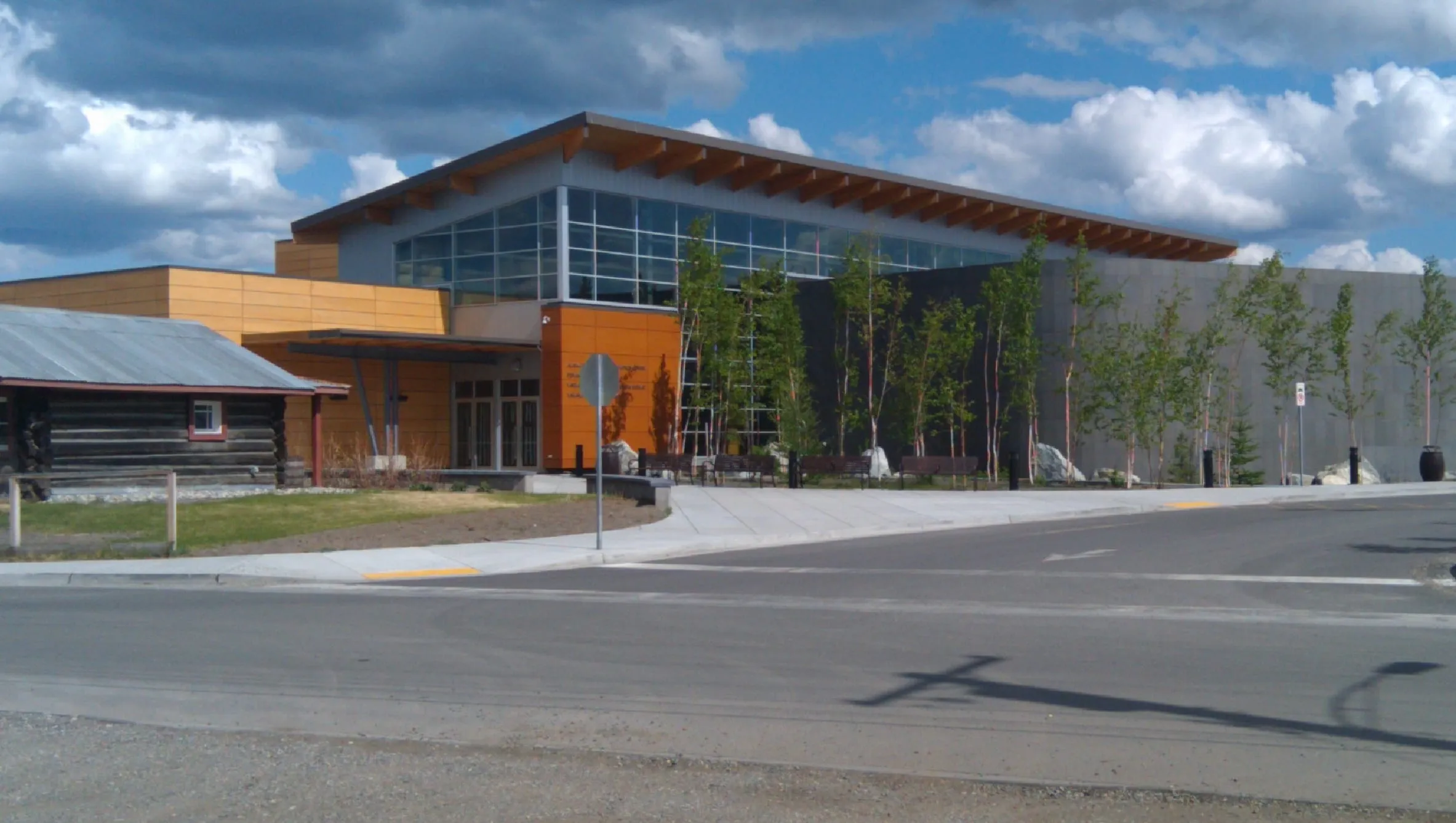
The center at 101 Dunkel Street, downtown, is open all year, and admission is always free. It is named for Morris Thompson, whom the center calls “a Koyukon Athabascan, born in 1939 in the village of Tanana,” where the Yukon and Tanana rivers meet. He studied civil engineering at the University of Alaska Fairbanks, became Commissioner of the Bureau of Indian Affairs at 34, joined his Native corporation, Doyon, Limited, in 1981, and was its chief executive by 1985. He was laid to rest in Tanana. The center, dedicated to his spirit of respect, communication and cooperation, calls itself “Big’s Place,” after his nickname, Big. Inside:
- How We Live: The People and the Land, the permanent exhibit: three life-size dioramas of the Interior’s seasons. In summer, a fish camp at Nuchalawoyya, where the Yukon and Tanana rivers meet, with a real smokehouse brought from the fish camp of Morris Thompson’s sister; in fall, a hunter’s camp, with a grizzly digging for ground squirrels just outside it; in winter, the inside of a public-use cabin, with a sunset and northern lights show outside its window and a moose looking in. Films, art and cultural objects follow, and the Elders Hall honors the peoples who, the center says, have been in the Interior for over 14,000 years.
- The Language Nook, on Alaska Native languages in the voices of their speakers and learners: a game teaches the animal names in Denaak’e and Gwich’in, and Chief Peter John tells a story in Lower Tanana Athabascan, with an English translation to follow.
- An exhibit on the Alaska Native Claims Settlement Act of 1971, which, as the center sets it out, extinguished aboriginal land title in Alaska and created twelve regional and more than 200 village Alaska Native corporations, owned by their Native shareholders.
- The Alaska Public Lands Information Center, a multi-agency visitor center in Suite 110, whose rangers help plan trips onto public lands, show a free film on Alaska’s national parks, natural resources, culture and history, stamp National Park passports and award Junior Ranger badges.
- Explore Fairbanks’s visitor center, for services and events in town.
- The Alaska Native gift shop, with handcrafts made by Denakkanaaga Elders and Tanana Chiefs Conference region artists: moose hide slippers, beadwork, carvings, birch bark baskets and jewelry, every piece bought directly from the artist who made it. Denakkanaaga’s own gift shop is open Monday to Friday, 10 a.m. to 4 p.m., and it holds a pop-up sale of Elders’ artwork at its office on the second Friday of every month.
The exhibits are about 75 feet from the front door and about 300 linear feet of walking, wheelchair accessible by ramps, with low lighting in parts. Courtesy transport chairs can be borrowed inside, the National Park Service desk lends audio-description devices for the exhibits at no charge, and only service animals may come in. Yukon Quest Alaska names the center as its race start; the 2027 start’s day and time are on our winter calendar.
The center’s hours, as it gave them on 23 November 2026, with the note that its open days and hours are subject to change:
| Dates | Monday to Friday | Saturday and Sunday |
|---|---|---|
| 1 October to 30 April | 8 a.m. to 5 p.m. | 10 a.m. to 5 p.m. |
| 1 to 28 May | 8 a.m. to 8 p.m. AKDT | No hours given |
| Memorial Day to Labor Day | 8 a.m. to 6 p.m. AKDT | No hours given |
It closes on Thanksgiving Day, 26 November 2026, on Christmas Day and on New Year’s Day, and at 3 p.m. on 24 and 31 December. The center gives no hours at all for the days between 28 May and Memorial Day, or from Labor Day to 30 September. The photograph after this article shows the center in May 2011, with an old log cabin beside it.
The Festival of Native Arts, 25 to 27 February 2027
The university’s Festival of Native Arts holds its 2027 festival, “Growing Our Roots, Shaping Our Future,” from Thursday 25 to Saturday 27 February in Davis Concert Hall on the Troth Yeddha’ Campus. Doors open at 5 p.m. and performances begin at 6 p.m. AKST each evening, and admission is free. Vendors come too: the festival closed its vendor applications on 11 October 2026, and its performer applications on 25 October.
The festival began in 1973, when University of Alaska Fairbanks students and faculty set out to hold a spring festival of the artistic expressions of each Alaska Native culture. In less than three months, Native artists, craftspeople and dancers from all the major Native culture groups gathered at the university, and the festival became an annual event. UAF’s Native students now plan and produce it, year-round, alongside their studies. It brings together the major Native cultures of Alaska with groups from elsewhere in the United States and from countries such as Japan, Russia and Canada, and it welcomes everyone, Native or not. The festival posts recordings of its performances on YouTube.
It falls in the last week of February, with the aurora season still on; our winter calendar sets it beside the moon’s phases and the town’s other events, week by week.
The World Eskimo-Indian Olympics, 21 to 24 July 2027
The World Eskimo-Indian Olympics (WEIO) gives its 2027 dates as Wednesday 21 to Saturday 24 July, at the Carlson Center in Fairbanks, a stop on the MACS Blue Line. Its mission, in its own words, is “to promote the culture, social games, skills, dances, and traditions of Alaska, Greenland, Siberian, and Canadian Eskimos, and those of the American and Alaskan Indians and Aleuts.”
The games were first held in Fairbanks in 1961, as the World Eskimo Olympics, with contestants and dance teams from Barrow, Unalakleet, Tanana, Fort Yukon, Noorvik and Nome, and have been held every year since. In 1973 the board of the Tundra Times, the statewide Native newspaper that then sponsored them, renamed them the World Eskimo-Indian Olympics, to reflect the participants more accurately, and since 1976 an independent nonprofit has staged them. WEIO’s board has also approved an alternate name, registered with the State of Alaska: the World Exhibition of Indigenous Olympics.
The games test strength, endurance, balance and agility, as the village games they come from always have. WEIO calls the one-foot and two-foot high kicks its premier events: an athlete jumps to kick a ball hung in the air and must land in balance, and the ball goes up four inches after each successful kick. In odd years, 2027 among them, the one-foot high kick is taken off both feet. The other events include the knuckle hop, the ear pull and ear weight, the Dena and Eskimo stick pulls, the four-man carry, and Nalukataq, the blanket toss, in which a jumper can go as high as thirty feet; fish cutting and seal skinning are judged on speed and neatness.
On 23 November 2026 WEIO’s schedule page was still headed with its 2026 schedule. It listed general admission for ages 12 to 59 at $15, or $50 for a season pass; $10, or $30 for a season pass, for active-duty military, seniors 60 to 79 and youth 6 to 12; a family season pass for two adults and two children or seniors at $144; children 0 to 5 and elders 80 and over free; and its daytime events free, with no tax or fee listed beside any price. For the rest of a July trip, our Fairbanks summer tours page has the day trips.
Fitting them into a day
In winter both fit one day with time to spare. The Morris Thompson Center opens at 8 a.m. on weekdays and 10 a.m. on weekends, and the museum at 9 a.m., with its doors closing at 5 p.m. Start downtown at the center, where the Public Lands rangers and Explore Fairbanks can help with the rest of the trip, then go out to the museum, about 15 minutes by car, and time your visit to take in the planetarium’s aurora show. Mind the closures: the museum on 26 November, 25 December and 1 January, the center on Thanksgiving Day, Christmas Day and New Year’s Day and from 3 p.m. on 24 and 31 December. Our things to do in Fairbanks in winter page has the rest of the daytime choices, and our Fairbanks itinerary fits the museums into a whole trip.
In summer the museum stays open to 7 p.m. AKDT every day, and the center to 6 p.m. AKDT on weekdays from Memorial Day.
If you would rather be driven, the guided city tours stop at both; our Fairbanks city tours page compares them and says which include the museum’s admission. Viator’s full list of what can be booked in Fairbanks is at the end of this page: check where each trip starts and whether it picks you up.